Cuban Adjustment Act of 1966
The Cuban Adjustment Act (CAA) is a United States federal law enacted on November 2, 1966. Passed by the 89th United States Congress and signed into law by President Lyndon Johnson, the law applies to any native or citizen of Cuba who has been inspected and admitted or paroled into the United States after January 1, 1959 and has been physically present for at least one year; and is admissible to the United States as a permanent resident.

Cubans in Cuba can legally migrate to the U.S. through various
migration programs that include immigrant visa issuance, refugee
admission, the diversity lottery, and the Special Cuban Migration
Program (SCMP), otherwise known as the Cuban lottery.
Immigrant visas
are issued to the parents, spouses and children (unmarried and under 21
years of age) of U.S. citizens as soon as the immigrant visa petition
is approved by the United States Citizenship and Immigration Services.
Immigrant visas are also available to a range of persons who can
qualify for family or employment-based visas under the preference system
that controls numerically limited immigration to the United States.
The preference system allows U.S. citizens to bring their
siblings and their adult married children to the United States. Lawful
permanent residents of the United States can petition for their spouses,
minor children, and unmarried adult children. The waiting period for
preference visas varies by category.
Those who have been persecuted in Cuba, or who fear persecution
(on the basis of race, religion, nationality, membership in a particular
social group, or political opinion), may apply for U.S. resettlement
through its in country refugee processing unit at the United States Embassy in Havana.
The diversity visa program is also available in Cuba. There are
55,000 visas available annually to eligible applicants from around the
world. For the three years that we have statistics, the success rate for
Cuban applicants is quite high. In 1996 approximately 67% of those
registered were issued visas, in 1997 the success rate was 69% and in
1998 a total of 73% of Cuban applicants who applied for the diversity
visa program were issued visas.
The Special Cuban Migration Program, or "Cuban lottery", is open
to all adult Cubans between the ages of 18 and 55 years of age who are
resident in Cuba regardless of whether they qualify for American
immigrant visa or refugee programs. The lottery provides an avenue of
legal migration to a diverse group of Cubans, including those who might
not have close relatives in the United States. The last registration
period was held from June 15 to July 15, 1998.
Modifications:
The original Cuban Adjustment Act of 1966 allowed Cubans to become
permanent residents if they had been present in the United States for at
least 2 years. The Immigration and Nationality Act Amendments of 1976 reduced this time to one year.
Cubans are exempt from any immigration quotas, and are also
exempt from the following requirements which are imposed on most other
immigrants:
- Showing a family-based or employment-based reason for residency
- Entering the United States at a legal port of entry
- Not being a public charge
The Cuban Adjustment Act remains in the books with little
modification. Migration flow and control has been a long standing peon
in U.S. Cuba relations, and there is not enough domestic clamor against
in the U.S., for the U.S. government to concede to Cuba's demands to
eliminate the law, according to expert Prof. Michael Bustamante.
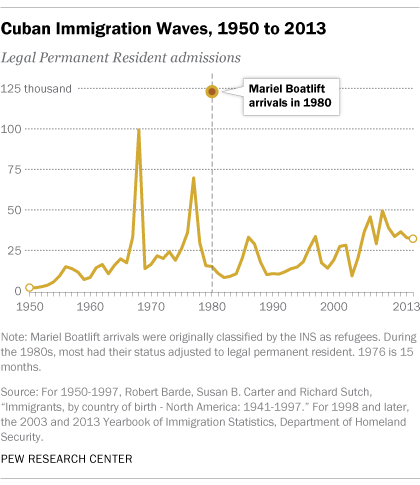
In 1996, the U.S. government introduced the so-called "wet feet, dry feet policy" which reduced the application of the Act. This was further reduced by executive orders signed by President Obama in 2016.
Links:
Комментарии
Отправить комментарий